 Massachusetts Drunk Driving Defense Lawyer DelSignore Law Home
Medical Defense in OUI / DUI Cases
Do you or have you ever had: |
A knee injury? |
A back injury? |
Injury to your legs that could impact balance in a field sobriety test? |
We can help you! Because your medical condition can affect the reliability of the breathalyzer test, the impression that the officer may have as to how you performed on the field sobriesty tests, and could help to explain observations of the officer that he or she attributes to being under the influence, medical evidence can assist in defending your Massachusetts OUI arrest.
There are 3 ways to present medical evidence relating to your performance on field sobriety tests: |
Testimony from treating doctor |
Testimony in the form of a sworn medical affidavit |
Through your own testimony explaining the injury or the testimony of someone with knowledge of your injury |
An injury could explain an officer’s observations of lack of balance or being unsteady while walking. When you have a medical condition unknown to the officer, a strong argument can be made that the officer could not accurately access your performance without knowing your medical condition and physical limitations.

Medical evidence can also be used at a breathalyzer refusal appeal when an individual has a lower lung capacity or trouble breathing into the machine; in many cases, the officer may attempt to deem this as a refusal of the breath test when a medical condition explains the inability to provide a breath sample. Medical evidence could be offered to contradict the claim that the motorist refused the breathalyzer. This evidence can be presented at the RMV to challenge a license suspension for refusing a breathalyzer test.

Since the accuracy of the breathalyzer machine is dependent on the assumption that the motorist is the normal or average individual, medical conditions sometimes undermine the assumptions made by the breathalyzer machine.
Are you a diabetic? We can help you! |
When in a state of ketoacidosis, a diabetic’s blood sugar raises as the body is unable to use carbohydrates as a source of fuel and burns stored fat as fuel and produces ketones. |
A breathalyzer machine may wrongfully detect ketones as ethyl alcohol and provide a blood alcohol reading that is falsely elevated |
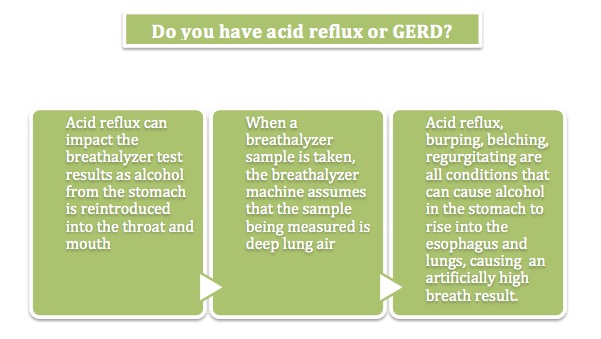
Breathalyzer testing machines are nonspecific for alcohol and do not test specifically for ethanol. There are many industrial compounds that contain a molecular structure similar to ethyl alcohol that a breathalyzer machine mistakes as alcohol.
Other compounds that can cause an artificially high breath result include: |
Toluene, which is found in industrial compounds (paint thinner, cleaning agents, and industrial products). |
Carpenters, plumbers, janitors, and other manual labors may have been exposed to these compounds, which would be registered as alcohol by a breathalyzer machine. |
To learn more about medical conditions that may be relevant to defending your Massachusetts OUI charge, you can download Attorney DelSignore free book or you may call to ask your questions directly at 781-686-5924.