 Attleboro Criminal Lawyer DelSignore Law Home
Massachusetts Restraining Order Violations
After a charge of domestic assault and battery is brought, often the victim will request a 209A restraining order. When a restraining order is served against you, it is not a criminal charge; however, a violation of the order will result in criminal charges being led. Typically, a 209A order by order you to stay away from the victim, refrain from going to their house or work.
A 209A restraining order is neither a felony nor a misdemeanor as it is not a criminal charge. A 209A Restraining Order Violation in Massachusetts is considered a domestic charge by most prosecutors’ of ces and will be handled in many cases by a domestic abuse prosecutor. Although it is not a criminal offense, violation of its terms will be considered a criminal offense.
209A Restraining Order violations are handled in the district court.
A 209A violation could arise out of an allegation that you made contact with an individual protected by a 209A order, by appearing either at their home, or their work or within an unacceptable close proximity as de ned in the 209A Order.
Other types of 209A violations including a new allegation off alleged abuse of the victim of the 209A Order: This could occur in a situation where you were charged with a domestic assault and battery or assault and battery and at the time of the alleged assault and battery there was an outstanding 209A Order.
Whenever you are charged with a domestic assault and battery and there is already an existing 209A Order, the case will be taken very seriously by the district attorneys and the potential punishment will be more severe as the court interprets the violation of the 209A Order as failure to comply with and obey court orders.
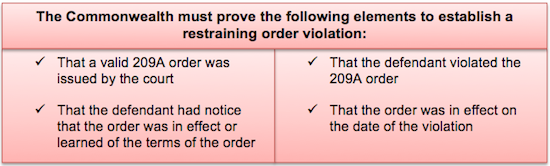
If you were charged with violating a 209A order, you may still have some legal defenses, including but not limited to:
- You were not served with the order;
- That the contact did not violate the terms of the order
- That it was unintentional and simply accidental contact.
- Even if there is a technical violation of the order, a technical violation will be treated by the court and
- prosecutors in terms of resolution of the case, different from a more deliberate or intentional violation of the terms of the order.
1. Call us to set up a free, no-obligation consultation to discuss a Massachusetts 209A restraining order charge or hearing. You can call Attorney Delsignore directly at 781-686-5924.
2. Recommended Reading: